
Solar Land Use Around the World
Solar power guestimates for 2026
Someone on Reddit made a dumb* statement and I want a handy way to estimate how wrong they were. The claim was that solar and storage would be insufficient for their unidentified small country to provide sufficient power for them and only a nuclear reactor would meet their low carbon needs. (I did concede that a high enough population density with a sufficiently high power demand might not make the grade) **
First lets get some data. We need a list of nations by population density, thank you Wikipedia.
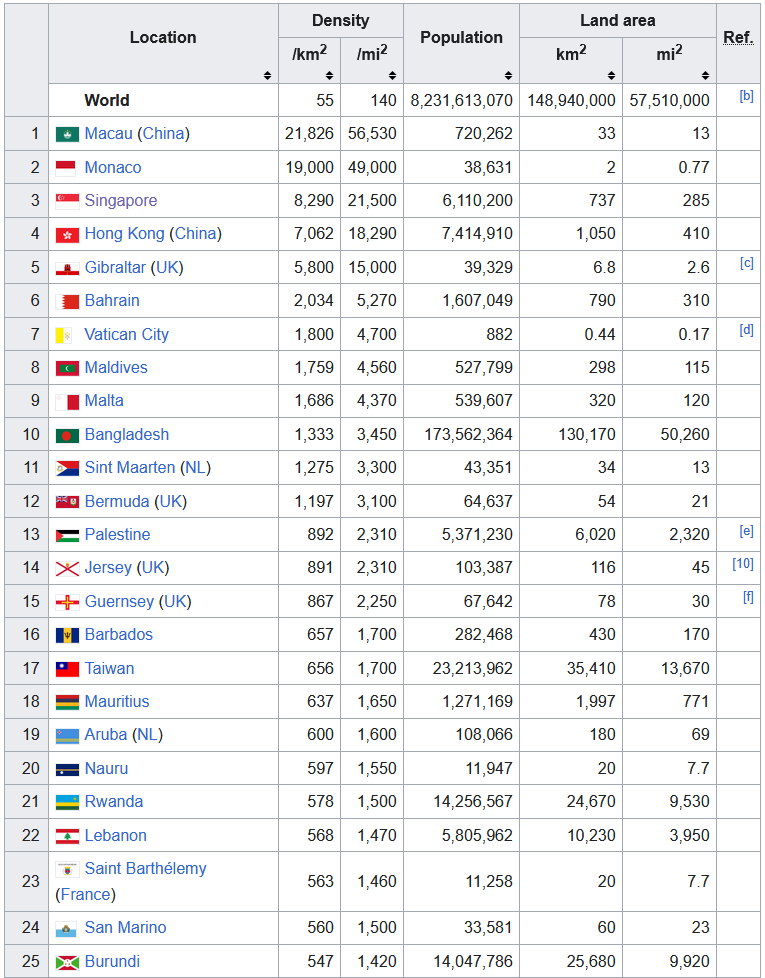
Thank you Wikipedia entry for countries and dependencies by population density. This was taken March 12 2026.
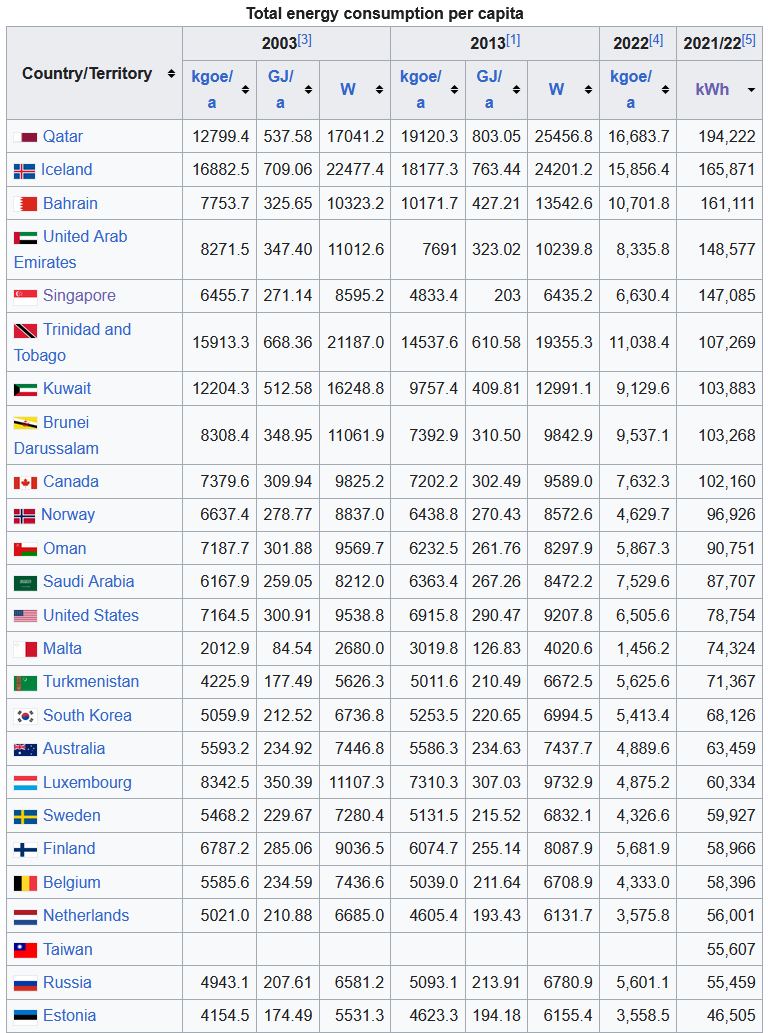
Another thanks to Wikipedia and all the editors who help make data like this easy for a lazy guy to track down. (Screen shot taken from “LIst of countries by energy consumption per capita” and grabbed on March 12 2026)
Out best bet for a country that it would be unrealistic to produce all power locally is Singapore, high population density, small land mass, with a large power demand per capita.
147,100 kWh per person per year. Population density of Singapore is ~8300 people per square kilometer.
Now we spend a few minutes doing some basic first order approximations and see where the estimation Take your population density, multiply it by your per capita energy consumption and you have how much power per square kilometer you need to produce each year. Divide the annual power consumption by how much power per square kilometer you get each year, multiply by 100% and you have the rough percentage of land you would need for 100% locally produced solar power.
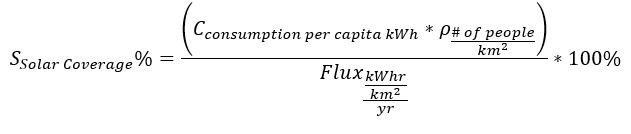
According to the global solar atlas one square meter of land in Singapore is estimated to produce between 900-1300 kWhr/year. For 900 kWhr/m^2/yr, you would need to cover 131% of the land mass of Singapore to meet the entire country’s energy demands. At 1300 kWhr/yr they would need to cover 94% of their country with solar panels. Our lower productivity is physically impossible, and the higher productivity would mean the vast majority of residents would have a hard time seeing daylight, far from ideal*.
The amazing news is that Singapore is truly the exception. Every other country that consumes that level of power has way more land mass to distribute renewable energy production on.
So how much land do you need to meet your per capita energy needs?
Well like all real world answers, it depends.
Low power consumption per capita, or low population density allows you to get by with relatively small amounts of land devoted to solar power production. For example if you have the population density of Nebraska, 10 people per square kilometer using power at about 2.5x the rate of the average American, even with the worst available solar production for that state ( 1400 kWhr/yr/m^2) you would need less than .2% of the available land in the state. This also ignores the fact that solar panels can be located on rooftops, over parking lots, and even implemented as a complimentary part of a farming set up (for a subset of crops that I am not quallified to meaningfully comment on).
As we increase our population density, we do start running into the limits of fully locally produced power using exclusively solar energy. New Jersey, the US state with the highest density, has the potential to produce about the same amount of solar power per square meter as the values used in the Nebraska estimation, but with 49 times the population density. Land use becomes an actual concern. Assuming residents of New Jersey consume power at a rate equal to the American national average of 78,000 kWh per person annually, it would take about 2.8% of the state being covered in solar panels to meet their needs.
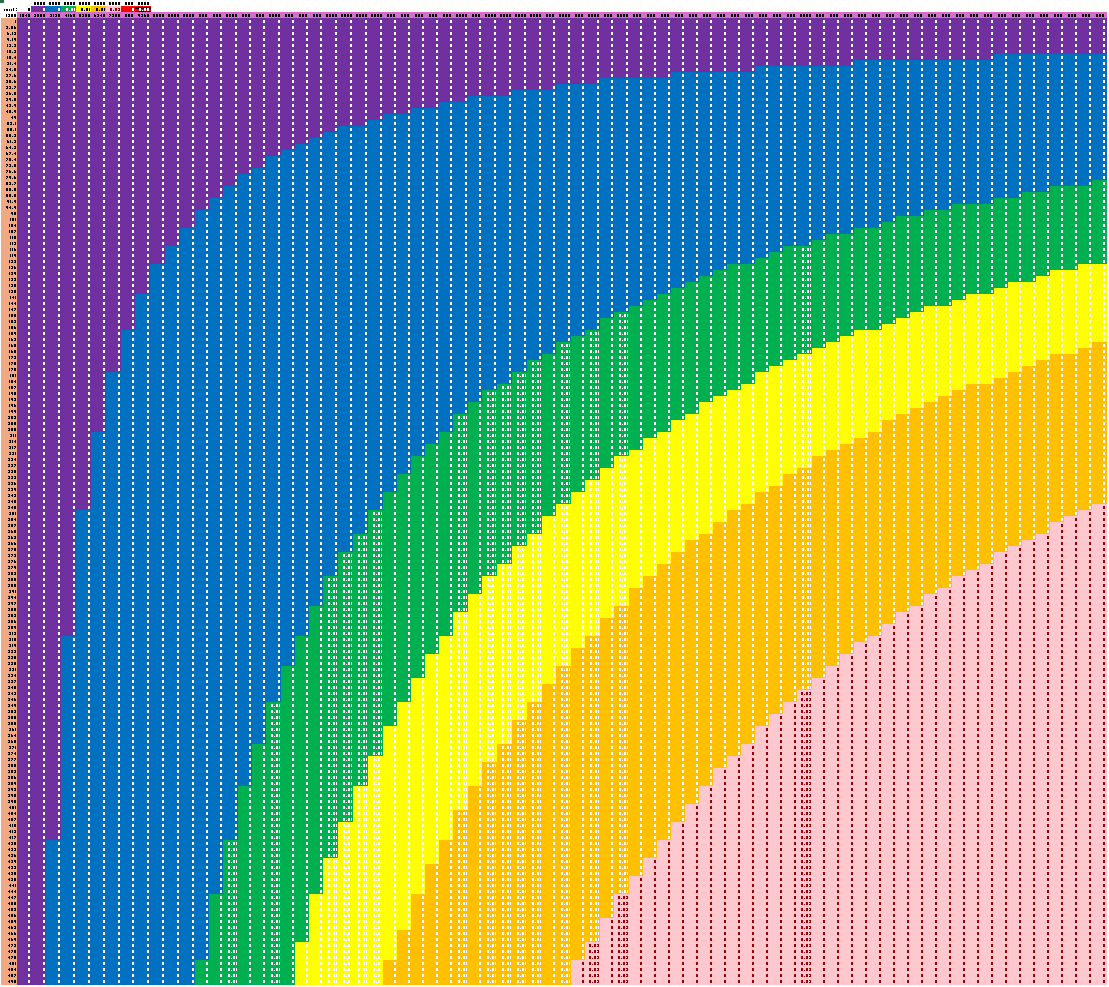
Chart showing the land use requirements for ever increasing population densities (along the y axis) with respect to per capita energy consumption x axis
Various annoying people would say, “we can’t devote 3% of New Jersey to solar power, we need to do X:” Let’s put that ~3% of New Jersey statistic in context. According to the US Dept of Agriculture roughly 40% of New Jersey’s 4.7 million sq acres of land is already urban space. This means that even if New Jersey only produced power on Urban land you are looking at roughly 7% of urban land having solar panels, nowhere else in the state. You put some panels over roads (please not as a road surface), crop land that compliments those panels, things start to feel pretty manageable. Now if we include the output of the state’s nuclear power plants, wind turbines, maybe some geothermal power, we need far less land being shared by solar panels.
It turns that annoying comment on Reddit wasn’t wrong, they clarified after I asked that they were from Singapore, which as we have shown cannot reasonably meet all of its needs using local solar. They also represented the ultimate edge case.An incredibly small land mass, with a high population, very little water territory, and incredibly high per capita power consumption. For most of the world’s population, solar power and grid storage could be all that is needed (assuming battery costs continue to drop). Even in the case of Singapore consuming too much energy to make it all from truly local solar, it doesn’t eliminate solar as an energy, we are just confirming that for this particular city state the power mix needs to be a bit more complicated. Co-located solar panels on rooftops, shading playgrounds, would not impede land use, all while reducing the amount of energy that would need to come from other sources.
Hopefully this was interesting. Trying to get back into the groove of things. After having kid number 2 my brain has gotten pretty mixed up and I am out of practice on writing posts, but wanted to explore the topic
If you want to download the excel file to make your own visualization please use this link. You can fool around with population densities, per capita power user, as well as annual solar flux. If you have a better tool and want to share, I am happy to add a link.
*citation needed
**I would like to be clear that I am for any lower carbon energy solution, alas nuclear power plants are running against some pretty rough economics that limit their application, and until I see some peer reviewed data I will remain skeptical on new nuclear power plants.